
Scotland is famous world wide for it’s castles and beautiful scenery. With so many castles in Scotland it would take quite a few tours to see them all! They are all beautiful and all worth visiting so it it can be hard to choose where to start so we have put together this short list of 10 of our favourite Scottish castles to visit.
10. Dunrobin Castle
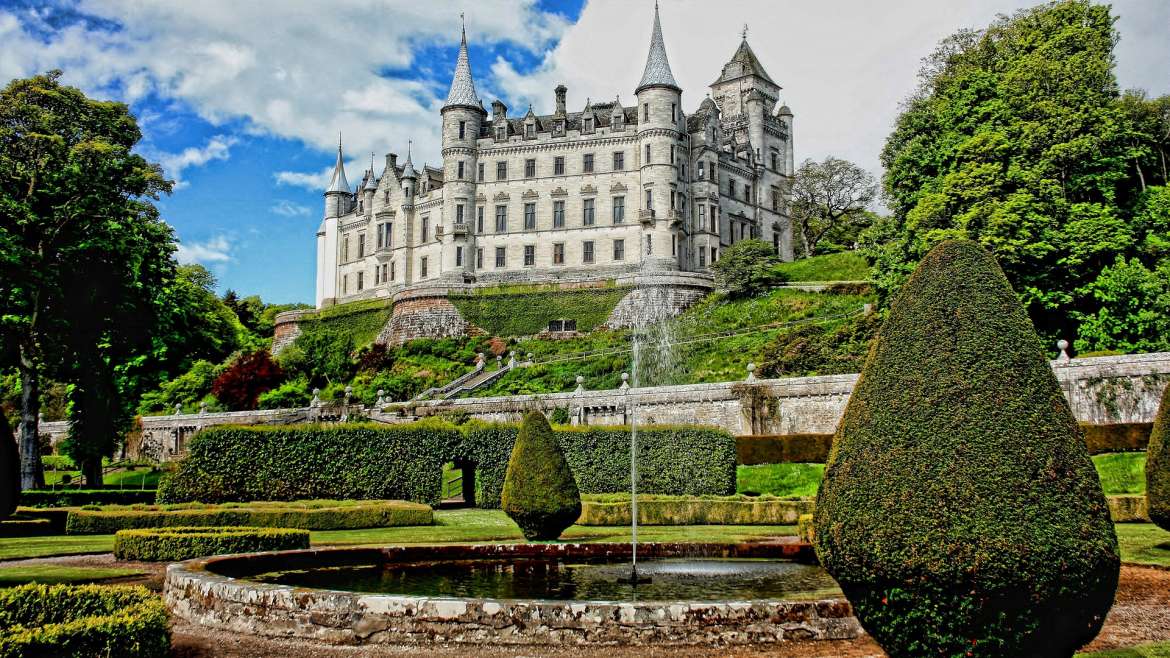
The main image above is a picture of Dunrobin Castle. This beautiful castle was built in the early 1300’s but most of the present building and the gardens were added by Sir Charles Barry between 1835 and 1850.It is also one of the oldest continuously inhabitted houses. Dunrobin Castle is on the east coast of the Northern Highlands overlooking the Moray Firth.
9. Eilean Donan Castle 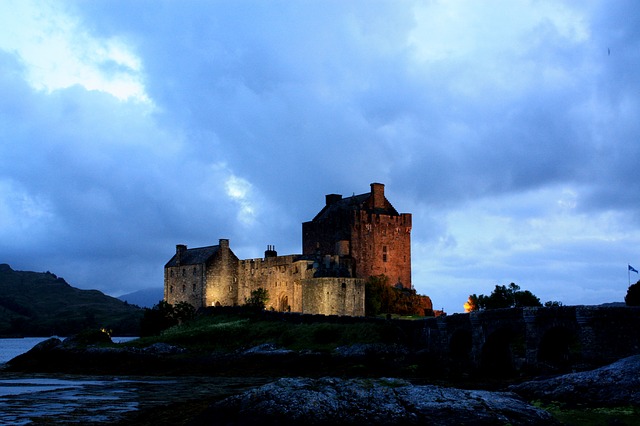
The castle was built in the thirteenth century, and became a stronghold for the Clan Mackenzie and their allies the Clan Macrae. In the early eighteenth century, the Mackenzies’ involvement in the Jacobite rebellions led in 1719 to the castle’s destruction by british government ships and using the gunpowder found at the castle it was blown up. In the early part of the 20th century Lieutenant-Colonel John Macrae-Gilstrap purchased and rebuilt the castle to its former glory.
8. Stirling Castle 
The first part of this castle was built in the 12th century and the principal buildings of the castle date from the fifteenth and sixteenth centuries. A few structures of the fourteenth century remain, while the outer defences fronting the town date from the early eighteenth century. This is one of the largest and most important castles in Scotland. This castle has been the birth place for royals and it has also seen a several crownings of Scottish Kings and Queens including that of Mary Queen of Scots in 1542. There have been numerous seiges and deaths the last seige being in 1746 led by Bonnie Prince Charlie unsuccessfully.
7. Balmoral Castle 
Balmoral has been one of the residencesfor members of the British Royal Family since 1852, when the estate and its original castle were purchased privately by Prince Albert, Consort to Queen Victoria. They remain as the private property of the royal family and are not the property of the Crown Estate. Soon after the estate was purchased by the royal family, the existing house was found to be too small and the current Balmoral Castle was commissioned. The architect was William Smith of Aberdeen, although his designs were amended by Prince Albert. The new castle was completed in 1856 and the old castle demolished shortly thereafter.
6. Dean Castle 
The Boyd Family came into possession of the grounds of Dean Castle in 1316, when Sir Robert Boyd was rewarded the lands of Kilmarnock and West Kilbride by King Robert l for his services at the Battle of Bannockburn. Dean Castle is situated in the Dean Castle Country Park in Kilmarnock, East Ayrshire,Scotland. It was the stronghold for theBoyd Family, who were lords of Kilmarnock for over 400 years. The Castle takes its name from ‘The Dean’ or wooded valley, a common place name in Scotland. However, until about 1700 it was called Kilmarnock Castle. Owned originally by the Boyd family, it has strong historical connections with many people and events famous in Scottish history. Robert The Bruce who gave the Boyds these lands; James III of Scotland whose sister married a Boyd; the Covenanters, some of whom were imprisoned here; Bonnie Prince Charlie, whose rebellion was joined by the 4th Earl of Kilmarnock and Robert Burns who was encouraged to publish his poetry by the Earl of Glencairn who owned the Castle at that time.
5. Kelburn Castle 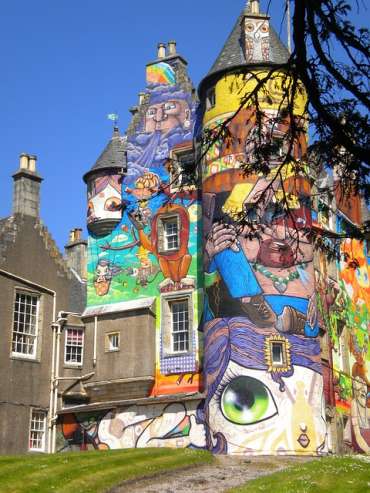
The Boyle family have been in possession of the lands of Kelburn since the 12th century. Kelburn Castle is a large house near Fairlie, North Ayrshire, Scotland. It is the seat of the Earl of Glasgow. Originally built in the thirteenth century (the original keep forms the core of the house) it was remodelled in the sixteenth century. In 1700 the first Earl made further extensions to the house in a manner not unlike a French château which is virtually how it appears today. In 1977 the house and grounds opened to the public as a country park. It is one of the oldest castles in Scotland and has been continuously inhabited by the same family for longer than any other. The castle is protected as a category A listed building, while the grounds are included in the Inventory of Gardens and Designed Landscapes in Scotland. When it was found in 2007 that the castle’s concrete facing would soon need replacing, Lord Glasgow invited four Brazilian graffiti artists to decorate the walls. This was still in place in 2011, when the Earl sought permission from Historic Scotland to keep the graffiti permanently.
4. Glamis Castle 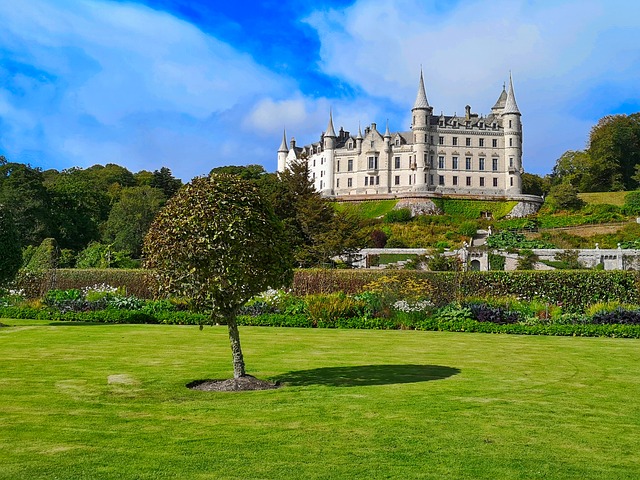
Glamis Castle is situated beside the village of Glamis /ˈɡlɑːmz/ in Angus, Scotland. It is the home of the Earl and Countess of Strathmore and Kinghorne, and is open to the public. Glamis Castle has been the home of the Lyon family since the 14th century, though the present building dates largely from the 17th century. Glamis was the childhood home of Queen Elizabeth The Queen Mother, wife of King George VI. Their second daughter, Princess Margaret, Countess of Snowdon, was born there. The castle is protected as a category A listed building, and the grounds are included on the Inventory of Gardens and Designed Landscapes in Scotland, the national listing of significant gardens.
3. Fyvie Castle 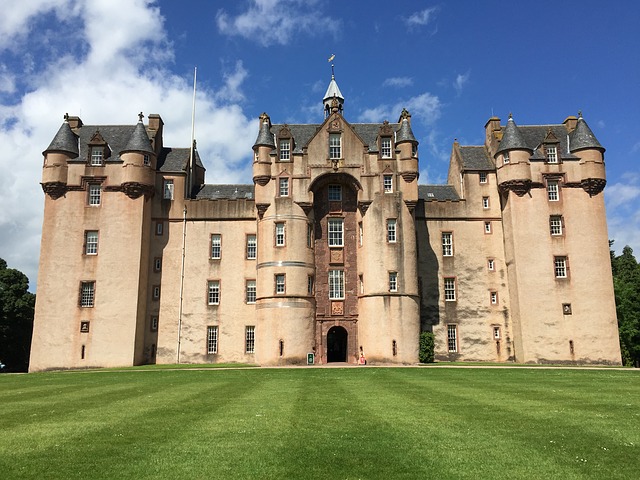
Located in Aberdeenshire near Turriff, The earliest parts of Fyvie Castle date from the 13th century – some sources claim it was built in 1211 by William the Lion. Fyvie was the site of an open-air court held by Robert the Bruce, and Charles I lived there as a child. Following the Battle of Otterburn in 1390, it ceased to be a royal stronghold and instead fell into the possession of five successive families – Preston, Meldrum, Seton, Gordon and Leith – each of whom added a new tower to the castle. The oldest of these, the Preston tower (located on the far right as one faces the main facade of Fyvie), dates to between 1390 and 1433. The impressive Seton tower forms the entrance, and was erected in 1599 by Alexander Seton; Seton also commissioned the great processional staircase several years later. The Gordon tower followed in 1778 , and the Leith in 1890.
2. Craigievar Castle 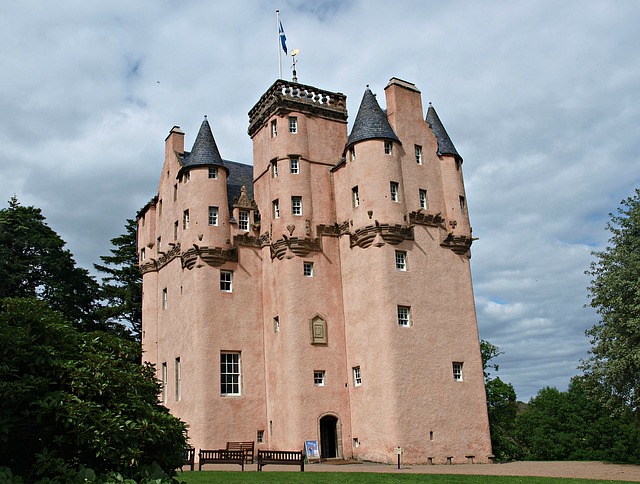
Craigievar Castle is a pinkish castle 6 miles (9.7 km) south of Alford, Aberdeenshire, Scotland. It was the seat of Clan Sempilland the Forbes family resided here for 350 years until 1963, when the property was given to the National Trust for Scotland by William Forbes-Sempill, 19th Lord Sempill. The setting is among scenic rolling foothills of the Grampian Mountains. The contrast of its massive lower storey structure to the finely sculpted multiple turrets, gargoyles and high corbelling work create a classic fairytale appearance.
1. Edinburgh Castle 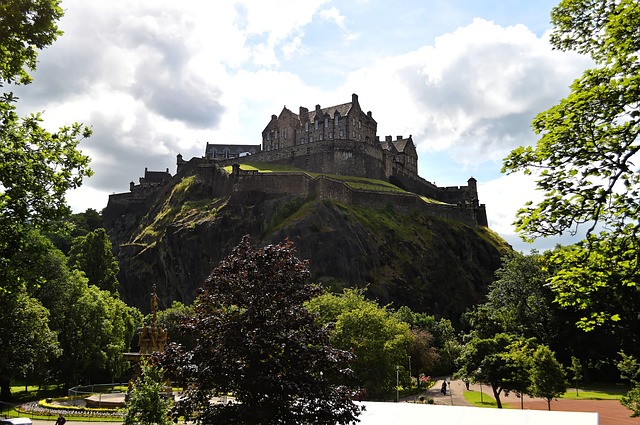
Edinburgh Castle is a historic fortress which dominates the skyline of the city of Edinburgh, Scotland, from its position on the Castle Rock. Archaeologists have established human occupation of the rock since at least the Iron Age (2nd century AD), although the nature of the early settlement is unclear. There has been a royal castle on the rock since at least the reign of David I in the 12th century, and the site continued to be a royal residence until 1633. From the 15th century the castle’s residential role declined, and by the 17th century it was principally used as military barracks with a large garrison. Its importance as a part of Scotland’s national heritage was recognised increasingly from the early 19th century onwards, and various restoration programmes have been carried out over the past century and a half. As one of the most important strongholds in the Kingdom of Scotland, Edinburgh Castle was involved in many historical conflicts from the Wars of Scottish Independence in the 14th century to the Jacobite rising of 1745. Research undertaken in 2014 identified 26 sieges in its 1100-year-old history, giving it a claim to having been “the most besieged place in Great Britain and one of the most attacked in the world”.
Book a tour and enjoy the history and beauty of Scottish Castles.
Add Your Comment